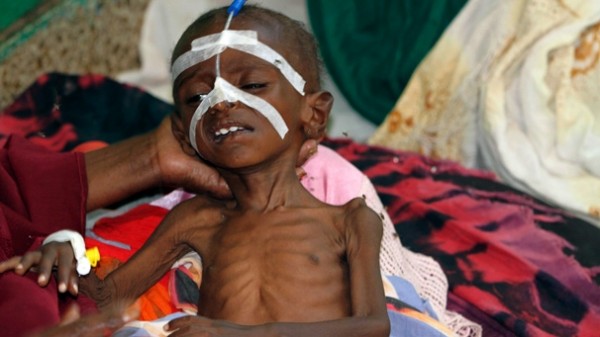
Horn of Africa: “The children’s famine” (image from www.euronews.net)
NEW YORK, USA, 1 August 2011 – As the crisis in the Horn of Africa deepens, the United Nations has warned that all of southern Somalia could slip into famine in the next two months. Hundreds of thousands of lives have been lost already, and many more are at stake, yet the international community remains slow in its humanitarian response.
In all, more than 11 million people desperately need help in the nations of eastern Africa stricken by drought, conflict and rising food prices. If the world doesn’t act quickly enough, some 566,000 children fighting severe malnutrition could lose their struggle to survive.
Among the most urgent needs in the crisis response are therapeutic food for malnourished children, safe water for tankering in drought-stricken areas, bed nets to prevent malaria, and family kits for people on the move – like the thousands of refugees who are crossing into Kenya from Somalia. Safe havens and learning spaces for children are priorities, as well.
Funding gap
“We have a huge need right now for airlift operations to get in the ready-to-use therapeutic food,” says UNICEF’s Director of Public Sector Alliances and Resource Mobilization, Afshan Khan. “So if there are in-kind donations in terms of airlift and air operations, that will be extremely helpful.”
Despite repeated warnings from many UN agencies that the situation in the Horn of Africa was critical, the response from donors – both public and private – has been limited. To date, UNICEF faces a funding gap of more than $200 million for its emergency operations in the region, including over $120 million for Somalia alone.
“Only when people started crossing the borders,” says Ms. Khan, “was the world able to see the severity of the situation that children really faced – the haunting images of children that were malnourished, dying not only from lack of food but lack of water.”
Child deaths are also occurring, she adds, “due to measles and [other] epidemics that could be easily fixed if we had sufficient resources to vaccinate children, to ensure they got appropriate nutrition … and the provision of clean water and sanitation.”
‘A moral obligation’
Droughts have become cyclical in eastern Africa, and 2011 has been the driest in 60 years. Add to that the recent sharp rise in food prices, a long-running conflict in Somalia and a lack of infrastructure, institutions and planning to prevent future crises, and you have the ‘perfect storm’ that is the current emergency.
Click to help now!
“There is a lot of work to be done in the short term to help address the immediate crisis,” says Ms. Khan, “but also in the medium and longer term, to build resilience and coping mechanisms of communities who by now have been hit with a cycle of drought and floods over a number of years.”
All eyes are now on the international community to take more concerted action on behalf of children at risk in the Horn of Africa.
“Children don’t choose where they are born, to whom they are born, what type of government rules them, what type of context within which they will grow up, thrive and survive,” notes Ms. Khan. “There is a moral obligation to respond in this crisis. We are all human beings.”
By Priyanka Pruthi
[source: http://www.unicef.org/emerg/index_59445.html]